


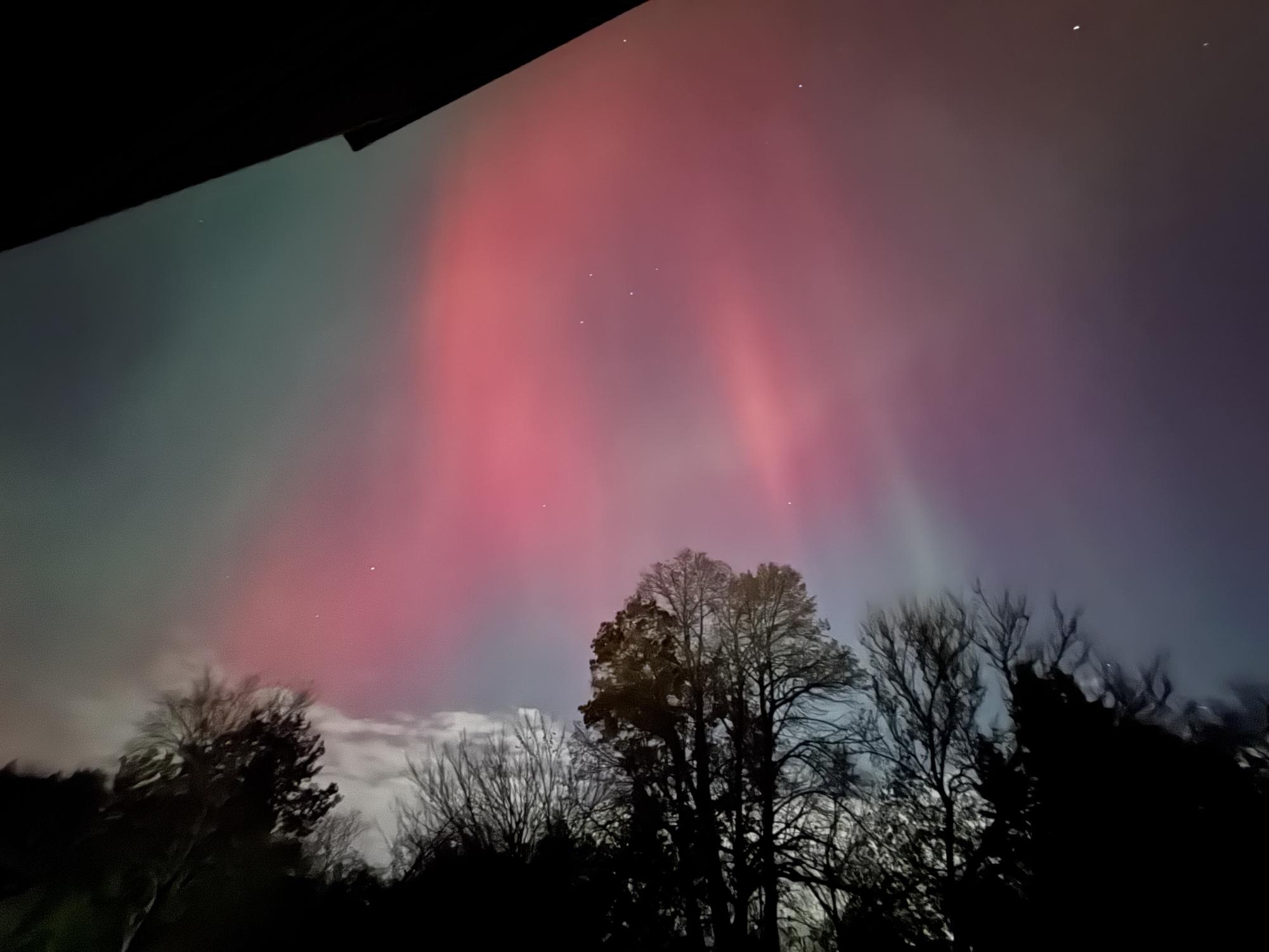
During the night hours of November 11, 12, and 13, 2025, the Northern Lights were reportedly seen across a large portion of the United States, including a bright and magnificent display in Northern Illinois. In this article, we will dive into the fascinating phenomenon of the Aurora Borealis, and provide tips on how to see it in the future. My personal footage of the Northern Lights is also linked at the end of the article.
What are the Northern Lights?
The Northern Lights, also known as the Aurora Borealis, are colorful displays of particles resulting from magnetism between the sun and earth, also known as space weather. The colorful glow of light in the Northern Lights is caused by the collision of energetic space particles with atoms and molecules present in the atmosphere. Solar wind, charged particles entering the solar system from the sun, deposits energy when interacting with Earth’s magnetic shield. The energy accumulates, and when released, flows into our atmosphere and creates auroras. Large instances of energy being sent through Earth’s atmosphere are called coronal mass ejections.
What causes the auroras to have different colors?
Auroras have different colors based on the type of atmospheric gas impacted by solar wind and the location of the gas in the atmosphere. Oxygen typically glows green if the gas has an altitude of 60-120 miles and red above 120 miles of altitude. Alternatively, excited nitrogen gas glows blue from 60-120 miles and reddish-purple from below 60 miles. These gases can also mix which results in a combination of colors.
What are the best places to see the Northern Lights?
A simple suggestion for viewing Northern Lights would be to use common sense and say to head up north; however, most people who don’t already live north will have to travel a fairly long distance to regularly see the Northern Lights. The best region to see the phenomenon is within the aurora oval, which is a donut-shaped belt around the Earth near the arctic circle. Inside the aurora oval, charged particles from the sun flow along the magnetic field lines towards Earth’s magnetic poles most consistently, therefore making auroras most commonly seen. While the aurora oval shifts nightly, the best places for viewing are the countries of Canada, Greenland, Sweden, Iceland, Norway, Finland, and Siberia in Russia, and the states of Alaska, Minnesota, the Upper Peninsula of Michigan, North Dakota, Montana, and Maine. Aside from the best viewing region, the prime specific locations within these areas include places with the lowest possible light pollution exposure, which includes but is not limited to parks, fields or open spaces, mountains, or very large bodies of water, such as large lakes or oceans.
What is the best time of the year to see the Northern Lights?
The optimal time of the year to view Northern Lights is between the autumn and spring equinoxes, or in more simple terms, winter. This is due to the later sunrise times and earlier sunset times which creates more hours of darkness. In addition, cloud cover is more prevalent during higher temperatures, so there are higher chances of having clear skies during winter’s cold nights.
What caused the Northern Lights to be visible in Illinois?
During the second week of November, powerful solar flares and coronal mass ejections were omitted from the sun during the morning hours of Tuesday, November 11, 2025. Solar flares reach earth in minutes, while CME’s take approximately 1-3 days; however, the last CME from that week’s geomagnetic storm was detected to be exceptionally strong and fast-moving. It entered Earth’s atmosphere in the hours from Tuesday evening to Wednesday morning, which was the duration of the best hours of viewing the display of the lights despite having occasional cloud cover. Wednesday evening into Thursday morning had mostly clear conditions and also presented a satisfactory display while the remaining energy from the geomagnetic storm entered the atmosphere.
Personal footage of the Northern Lights:
