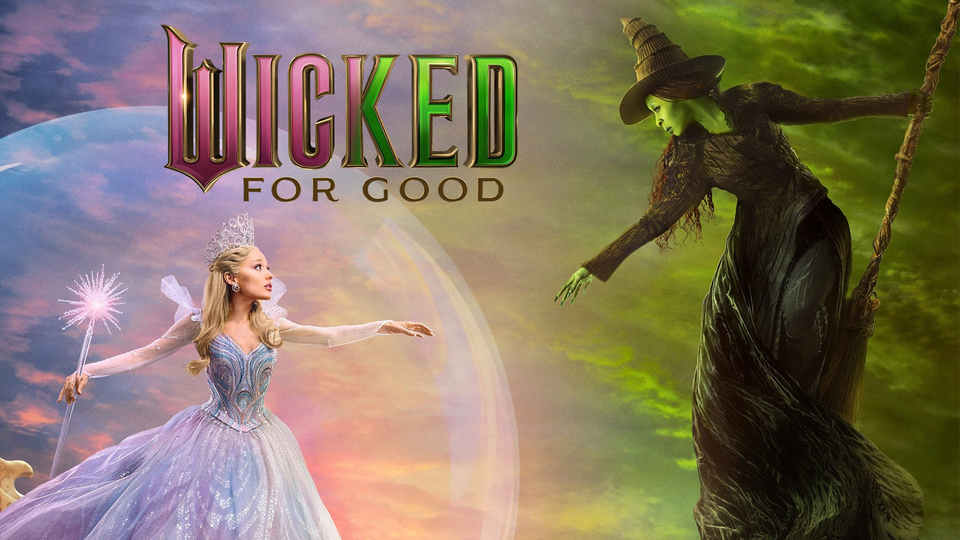
The new 2025 film, Wicked: For Good, based on the novel by Gregory Maguire, is a sequel to Wicked and brings the story to a close. Elphaba and Glinda navigate through the hardships of their world and attempt to bring “good” upon all of Oz. While Wicked: For Good succeeded in its visuals, casting, and costuming, it struggled severely in its pacing, storytelling, and plot. The following will include spoilers!
Positives
Wicked: For Good succeeded in its stunning visuals and intricate costume design. I would argue it is far better than the first movie in this aspect. One notable scene is set in a glass monorail. It allows the audience to see the glimmering city of Oz through the eyes of its citizens. It is utterly immersive. Pink posters of ‘Glinda the Good,’ now a spokesperson for the Wizard, are hung high from shiny green skyscrapers. Across from them is a propaganda poster warning against the Wicked Witch or Elphaba. Oz’s attitude toward the two main characters is revealed through these posters without directly saying it. The green and pink displayed throughout the city and the whole movie is both beautiful and meaningful. When Oz is first introduced in Wicked Part I, it is entirely green. Now, pink embellishments are a staple of the city. A representation of Glinda—an entirely pink character—and her increasing influence. There are two main settings, Oz as I just described where the Wizard and Glinda live and the Ozian Forest, where Elphaba lives. In the forest, there is giant green foliage everywhere you look. The city is also green but everything is curated by humans. It looks like it was made out of a precious jewel. Their homes can be seen as a metaphor for magic in the movie. Elphaba has a gift for magic, like the naturally occurring forest, while the Wizard and Glinda pretend to possess her power, like the carefully crafted green city. So not only is it stunning but meaningful for characterization. Alice Brooks, the movie’s cinematographer, and the director, Jon M. Chu, are responsible for thinking up these breathtaking visuals. VFX is a large part in creating the fantasy that is Wicked and the Production VFX Supervisors are Pablo Helman and Jonathan Fawkner. Along with Dale Newton, the Animation Supervisor.
Now, the visuals weren’t just landscapes and VFX. It was also a remarkable costume design. Paul Tazewell, costume designer, won an Oscar for Best Costume Design for Wicked Part I, becoming the first black man to win the award. So it was already good but I think this movie’s costumes exceed part one. To start, Elphaba’s black dress is now deteriorated. An indicator of her decision to leave all luxuries behind in pursuit of justice. She still has that old-timey witch look. The pointy black hat, the broom stick, the long black cape. I especially love the detail in her costume, something I’ll bring up repeatedly. The broom has gnarled twigs for a handle and frayed bristles and then there’s her long tattered cape that flows cinematically, almost like a superhero. She remains in this outfit for the whole movie (except for that one Fiyero scene) which is fitting for her character’s circumstances. Glinda, on the other hand, makes many costume changes so I’ll focus on my favorite. Her light lavender and pink wedding dress. The color palette was inspired by the Broadway version and 1939 version of Glinda. It has a deep sweetheart neckline and a ballgown skirt made of satin with tulle detail on the sides. There’s butterflies embroidered at the bottom of the skirt and glass and crystal beads all along the dress. Then there’s the veil, perfect for any bride. It has swirls that are also featured on the actual dress. What else can I say, it’s just that beautiful. 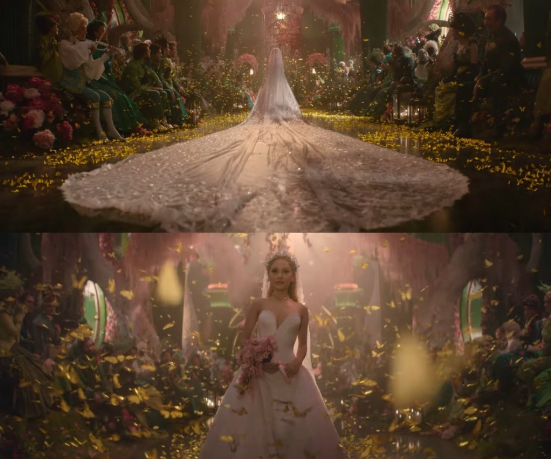
Something I love about the costumes in this movie is that you can see the quality in every piece. The same can be said for the VFX and the settings and the visuals as a whole. I commend the Wicked team for creating something so unique and breathtaking.
Negatives
While Wicked is applauded by many, this movie in particular lacked proper pacing and, unfortunately, contained many plot holes and inconsistencies. This was especially disappointing as the first film had so much potential with its storyline, casting, and resources; the sequel could have continued this legacy. For instance, Wicked focused heavily on the animal cruelty plot, in which the animals in Oz were being silenced, discriminated against, forced out of their homes, and even suggested themes of slavery. This dark and serious plotline ended abruptly with no explanation, and automatically disregarded years of struggle and prejudice as the animals were magically accepted back into Ozian society simply because Glinda said so. The first movie emphasized the growing hatred towards animals, and Elphaba’s entire motivation to visit the Wizard, and later to fight him, was to save the animals. Seeing this plot being thrown away just to support the idea that everything was “good” now was especially disappointing to watch. On the other hand, Wicked: For Good seemed to chase the plot of The Wizard of Oz rather than mesh with it; unlike the first film, it felt more like a fanfiction rather than its own piece of the Ozian universe. For example, the entire plot point about Fiyero being the Scarecrow was confusing and unexplained. While the Tin Man and the Lion genuinely fit into their roles and had proper characterization to explain why they became these characters, Fiyero becoming the Scarecrow felt like a cop out so that they could have someone to fill the role. First of all, Fiyero sacrificed his life for Elphaba when he did not need to; she offered to let him on her broomstick to escape, yet he refused. Both of them could have survived and continued to fight, yet he decided to die “for the cause,” which completely contradicts his character. He would have done anything to be with Elphaba because he loved her; he wouldn’t have killed himself just for the sake of being a hero. Similarly, Fiyero joining forces with Dorothy made zero sense. He himself knew the cruelty and insincerity of the Wizard, yet he led Dorothy to Emerald City to seek his help. In the Wizard of Oz, the Scarecrow is missing a brain, yet this is never mentioned or brought up, unlike the Tin Man’s heart and the Lion’s courage. Ultimately, Wicked felt like it was chasing the Wizard of Oz and simply shoving characters into roles they didn’t fit for shock value and to follow the story. Lastly, the pacing of this film was extremely confusing; it felt slow towards the beginning and rushed towards the end. At the start, the story was focused on the whereabouts of many characters and was very dialogue-heavy. On the other hand, the climax and end of Wicked were very fast-paced and hard to follow. From “No Good Deed” and on, the plot was full of action with no explanations, leaving viewers confused about many aspects of the storyline. For example, how Elphaba faked her death, why they couldn’t tell Glinda, why the animals could magically talk again, etc. In the end, Wicked: For Good struggled with its storyline and did not live up to the expectations set by the first movie.